
 EN
EN
Surface Preparation for Reliable Adhesion on Bidirectional Carbon Fiber
Proper surface preparation forms the foundation of durable bonds in bidirectional carbon fiber composites. Even minor surface contamination can reduce joint strength by over 30 percent, according to historical data on structural adhesive failures. The bonding process must eliminate invisible films that disrupt the critical fiber-matrix interface. Bidirectional carbon fiber fabrics frequently retain a sizing layer applied during the weaving process to stabilize tows during handling, which can act as a weak boundary layer if left untreated. Solvent wiping with high-purity isopropyl alcohol or acetone dissolves this coating while stripping away oils, dust, and handling residues.
Following solvent cleaning, thorough drying is critical because trapped moisture can vaporize during the cure cycle, creating internal voids that drop lap shear strength by up to 15 percent. A disciplined two-step sequence combining a solvent degrease followed by a short thermal bake ensures moisture content stays below 0.1 percent by weight. For high-volume production lines, automated plasma treatment provides a repeatable alternative, but manual solvent cleaning remains the most accessible method for field repairs and rapid prototyping.
The balanced 0/90 weave architecture requires a tailored mechanical abrasion strategy distinct from unidirectional tapes. Light sanding with 320 to 400 grit silicon carbide paper, applied at a 45-degree angle to the fiber axis, generates micro-roughness to maximize mechanical interlocking without cutting into load-bearing filaments. Uniform abrasion can raise interfacial shear strength by 20 to 25 percent compared to chemically cleaned surfaces alone. Following abrasion, the surface must be vacuumed and re-wiped with a lint-free cloth to eliminate loose debris. Consistent technique is essential throughout this stage, as uneven pressure creates low spots that trap air and lead to incomplete resin wetting of the 0-degree and 90-degree tows during subsequent lamination.
Adhesive Selection and Interfacial Engineering for Carbon Fiber Composites
The balanced 0/90 weave distributes applied loads equally in two orthogonal directions, requiring epoxy adhesives that exhibit isotropic mechanical properties and low curing shrinkage. Bisphenol-A epoxies paired with aliphatic amine hardeners provide an optimal balance of toughness and modulus while keeping internal stresses to a minimum. Selecting a resin with a glass transition temperature comfortably above the maximum operational service temperature prevents premature softening. Furthermore, adhesive viscosity must allow thorough wetting of dense fiber tows without creating excessive resin-rich pockets, and its elastic modulus should closely match that of the cured composite to suppress localized stress concentrations at the bondline. Properly matched epoxy chemistry ensures uniform stress transfer across both fiber axes, achieving lap shear strengths exceeding 25 megapascals under ASTM D1002 testing.
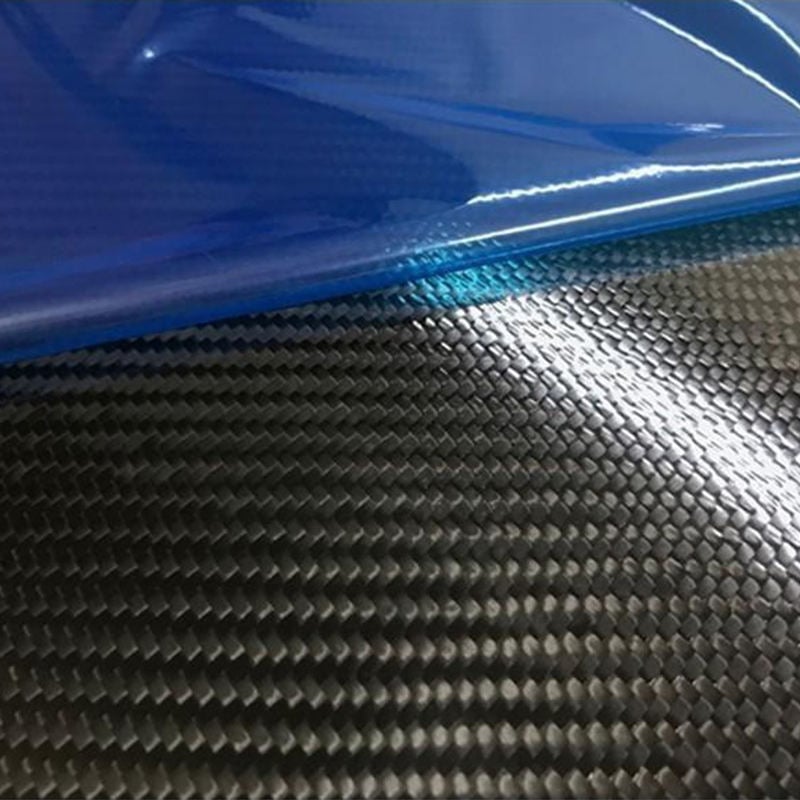
Integrating nanoscale additives into the epoxy matrix significantly boosts interfacial shear strength in bidirectional carbon fiber bonds. Silica nanoparticles sized between 10 and 20 nanometers or amino-functionalized carbon nanotubes enhance the adhesive modulus and fracture toughness. When uniformly dispersed, these particles bridge the fiber-matrix interface, arresting crack propagation and improving load transfer precisely where shear stresses concentrate at tow crossovers. Adding precise concentrations of amino-functionalized carbon nanotubes, for instance, raises interfacial shear strength by up to 40 percent compared to neat resin formulations. Nanoparticles also help mitigate thermal expansion mismatch, suppressing interfacial stress accumulation during thermal cycling. Effective dispersion and surface functionalization remain essential to prevent agglomeration and ensure predictable, consistent joint performance.
Process Control: Vacuum Bagging and Resin Infusion Strategies
The 0/90 fiber architecture creates an intricate network of capillary channels that resist uniform resin flow during infusion. Perpendicular tow intersections form micro-gaps where resin velocity drops sharply, making them primary locations for void nucleation. If resin reaches the 0-degree tows before fully saturating the 90-degree orientation, dry spots become permanent structural defects. Managing this flow behavior requires a diagonal infusion strategy, moving resin at an angle to both fiber axes so both orientations saturate at comparable rates. This cross-plied approach minimizes permeability disparities and prevents air entrapment at complex intersections.
Vacuum-assisted resin transfer molding provides the precise pressure control required for this methodology. Under a controlled pressure gradient, the process compresses the fabric stack and promotes thorough wet-out of all filaments. Strategically placed flow media and distribution channels guide the infusion front, preventing surface channeling and unsaturated pockets in lower laminate layers. A staged vacuum profile—initiating high vacuum to evacuate trapped air, followed by reduced pressure during infusion—slows resin advancement enough to guarantee complete saturation of intersecting tows. This method reduces void content below 1 percent in finished laminates, directly correlating with a 25 percent increase in interlaminar shear strength compared to parts burdened by higher void fractions.
Curing and Joint Design to Counteract Thermal Expansion Mismatch
Effective curing of bidirectional carbon fiber epoxy bonds demands exact control of time, temperature, and pressure to attain optimal crosslink density. Incomplete cure leaves residual unreacted epoxy groups, depressing the glass transition temperature by as much as 15 degrees Celsius and degrading long-term dimensional stability. A multi-step ramp profile—beginning with a low-temperature gelation stage to initiate network formation, followed by a controlled high-temperature post-cure—ensures full chemical conversion. Overheating must be strictly avoided to prevent matrix degradation and embrittlement. Vacuum bagging within specific bar ranges prevents void formation while maintaining uniform resin flow across the 0/90 weave; excessive pressure squeezes out vital resin, whereas insufficient pressure permits outgassing. The resulting crosslink density directly dictates the coefficient of thermal expansion, where a fully cured laminate achieves in-plane values below 1 part per million per degree Celsius to minimize cool-down warpage. Differential scanning calorimetry analysis confirms cure conversion exceeding 95 percent, validating structural integrity.
Bidirectional carbon fiber composites possess low through-thickness strength, making bonded joints exceptionally vulnerable to peel failure when mated to structural metals with high thermal expansion coefficients. While a carbon-epoxy laminate exhibits an in-plane thermal expansion coefficient near 1 part per million per degree Celsius, aluminum expands at 23 parts per million per degree Celsius, generating severe interfacial shear stresses during temperature fluctuations. To resist peel forces, joint geometry must convert peel loads into manageable shear stresses. Scarf joints featuring a tapered configuration and stepped-lap arrangements distribute stresses over a wider surface area. Adhesive thickness is equally critical; a controlled bondline gap accommodates differential thermal expansion without cohesive failure. In mission-critical hybrid assemblies, stress-relief features such as localized perforations or compliant interlayers absorb thermal strain, successfully lowering peak peel stress by over 40 percent compared to standard lap joints.
Frequently Asked Questions
-
What is the importance of surface preparation for bidirectional carbon fiber bonds? Proper surface preparation is crucial for ensuring strong and durable bonds. It removes contaminants, sizing residues, and moisture, which can weaken adhesion and reduce overall joint strength.
-
How does mechanical abrasion improve adhesion on a 0/90 weave architecture? Mechanical abrasion increases surface roughness, creating more area for mechanical interlocking. When done uniformly, it enhances interfacial shear strength while maintaining structural integrity.
-
Why are nanoparticles added to epoxy adhesives for bidirectional carbon fibers? Nanoparticles improve the adhesive's modulus and fracture toughness while enhancing interfacial shear strength. They help resist crack propagation and improve load transfer, especially at tow crossovers.
-
What are the key considerations for curing bidirectional carbon fiber epoxy bonds? Precise control of time, temperature, and pressure during curing ensures optimal crosslink density, dimensional stability, and resistance to thermal cycling. Over-cure or under-cure can compromise performance.
-
How can thermal expansion mismatch between carbon fiber and metal joints be minimized? To counteract mismatch, joint designs such as scarf joints or stepped-lap configurations are used to distribute stress. Adhesive thickness and stress-relief features also help accommodate differential thermal expansions.